Birds of the Blue Ridge: Downy Woodpecker

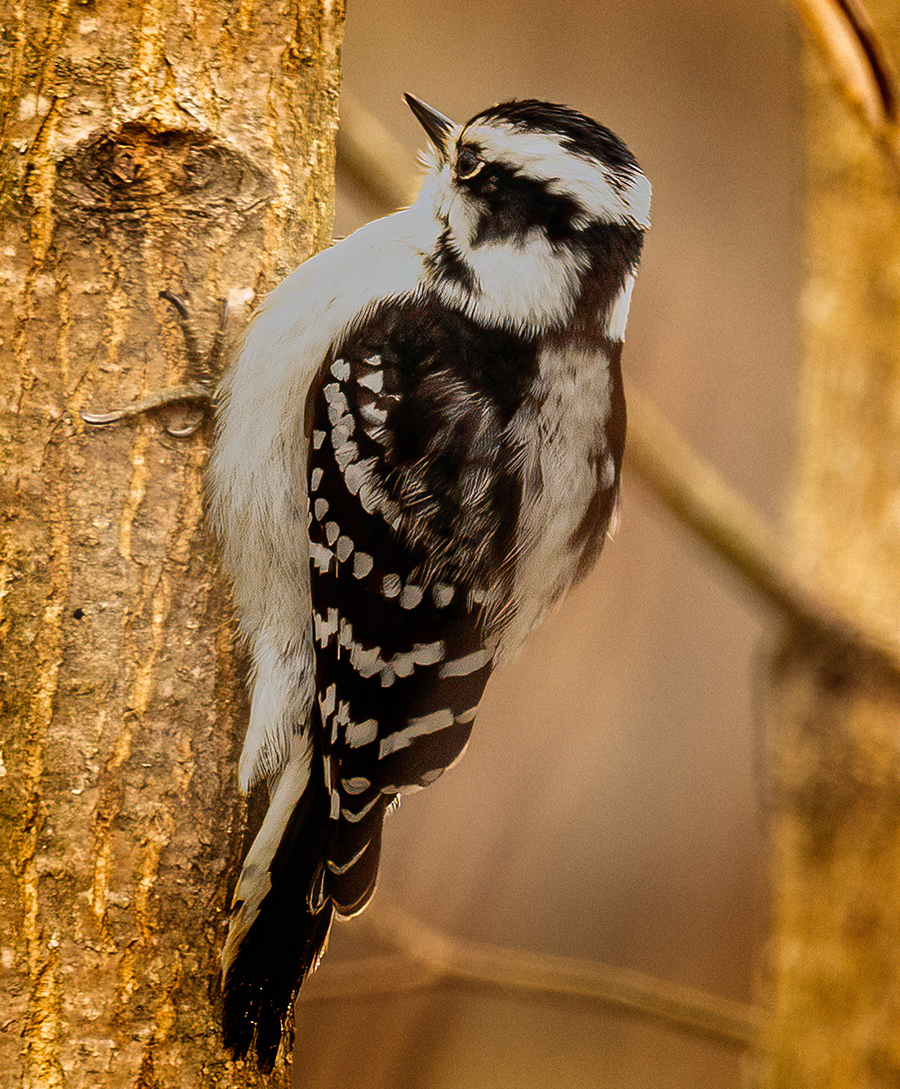
Downy Woodpecker, female

The concert season for percussionists of the bird world has begun…starring woodpeckers.

From early spring to mid-summer these talented drummers perform different styles depending on their purpose and audience. The slower, softer taps interspersed with pauses indicate either nest building or food hunting. Technically proficient, rapid sounds attract mates and/or establish territory. For the latter, the Downy Woodpecker has been clocked at 16 to 17 beats per second!

Both females and males drum, excavate the nest site cavity and feed and raise the nestlings.

Acrobatic in food gathering, the Downy Woodpecker is also fond of suet, sunflower seeds and the occasional sip from hummingbird feeders. With a regular food supply, they are quickly becoming members of the backyard bird feeder family.

In many First Nation cultures, the woodpecker symbolizes the “heartbeat of the Earth” and the black, white and red colors on the head remind us that clarity can be found when we use our mental abilities.
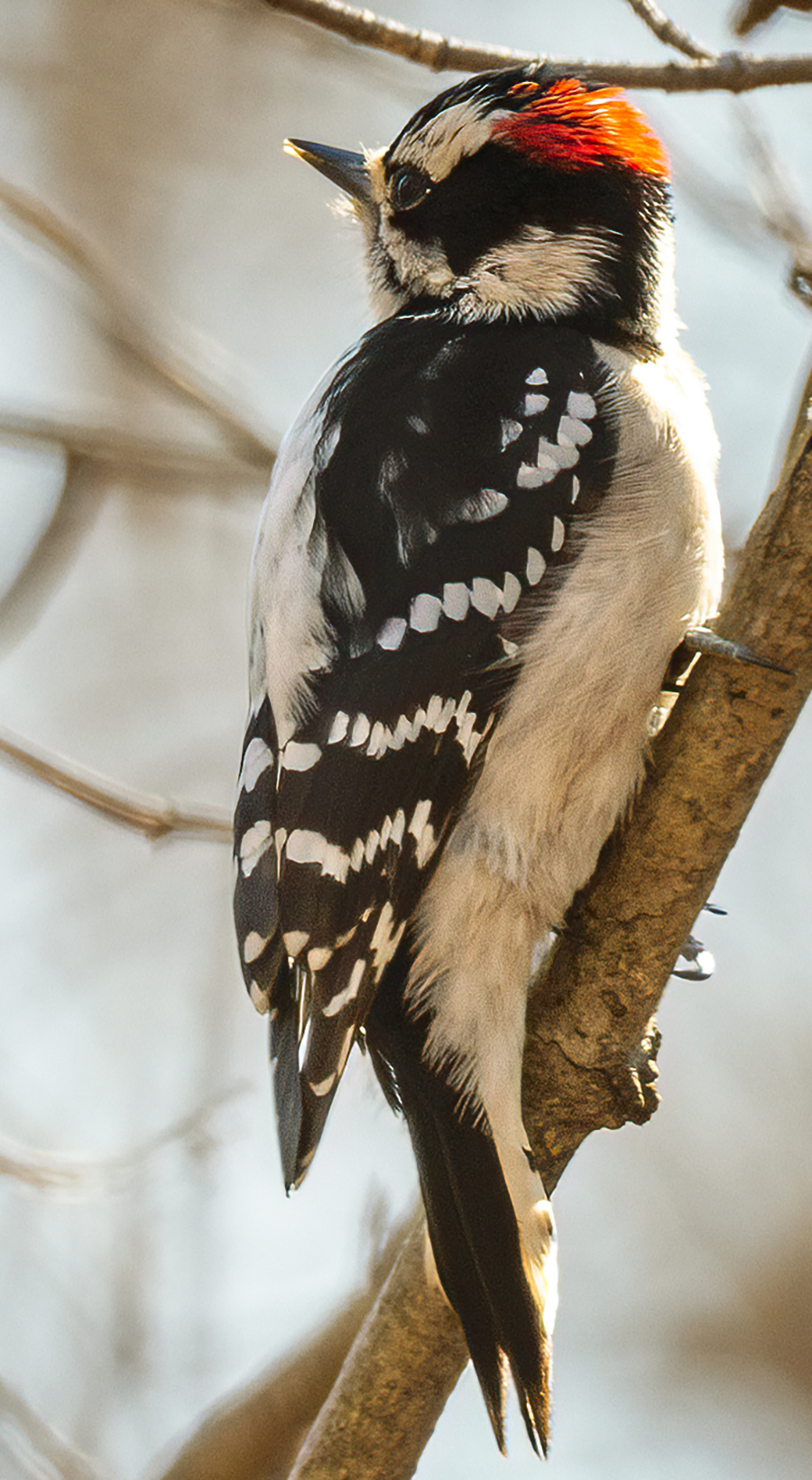
Downy Woodpecker, male

Fun Facts

An almost identical twin to the Downy is the Hairy Woodpecker. The latter is a bit larger (9.25 inches) with a larger bill that lacks a conspicuous tuft of tiny bristles at the nasal area. (You’ll want to focus the bins to see that last bit!)

How to Identify a Downy Woodpecker

As our smallest woodpecker, the Downy measures 6.75 inches and both sexes have whitish-gray underparts with white in the center of a black back and black-and-white spotted wings and outer tail feathers. The males have a signature red patch at the nape; females do not.

Downy Woodpecker Habitat

Found in several habitats including wild spaces, second-growth and suburban yards.

Conservation Note

Populations are stable.


ABOUT THIS SERIES:

“Birds of the Blue Ridge” showcases frequently seen and rare birds across the southern Appalachian region. For over four decades, Angela Minor has traveled with binoculars and field guides across the continental U.S., Alaska, the Caribbean and seven European countries. She is a contributing editor with BRC magazine and a freelance writer, penning travel and nature feature articles for several regional and national print publications. Angela created and authored the state park birding series for Bird Watcher’s Digest.

Read More by Angela Minor: BlueRidgeCountry.com/AngelaMinor

You Might Also Like:

e1b70596-05c8-11f1-92e0-1248ae80e59d-3-2026rueanemone--credit-Joe-Cook

March’s Mountain Wildflower: Rue Anemone

A member of the buttercup family and found in the open woodlands, rue anemone (Thalictrum thalictroides) has long, thin stems that tremble in the slightest of winds—prompting its other common name, windflower.
Pokeweed growing in Floyd County, Virginia.

January’s Wild Edible: Pokeweed

Pokeweed is one of the wild plants that is most associated with the Blue Ridge Region.
A purple-spored puffball growing in a field in Botetourt County, VA.

December’s Wild Edible: Purple-Spored Puffball

The purple-spored typically grows in this region’s fields, often appearing from October through December and into early January.
d289022c-696f-11f0-a179-1248ae80e59d-CGZ_0845-011

Ride the Rails, Explore Rockbridge County: Make a Weekend of the 611 in Goshen!

This fall, one of America’s most iconic steam locomotives is making tracks and memories.
The compound, lancelike leaflets of the bitternut are a good identifier.

November’s Wild Edible: Bitternut Hickory

Frankly, this native species to the Blue Ridge mountains comes by its name honestly.
Mullein growing in Ingram's backyard.

October’s Wild Edible: Mullein

Earlier, this year, a lone mullein plant appeared along the fence that encloses my garden, which made me curious about this plant.
An indigo milk cap growing in Botetourt County, Virginia.

September’s Wild Edible: Indigo Milk Caps

When young, indigo milk caps are one of the most stunningly beautiful mushrooms in the Blue Ridge Mountains.
ec3b964c-5201-11f0-968d-1248ae80e59d-9-2025spottedjewelweed--credit-Joe-Cook-and-Monica-Sheppard

September’s Mountain Wildflower: Spotted Jewelweed

Seek out spotted jewelweed growing beside a stream or along a moist area and you will have a good chance of getting to watch one or more ruby-throated hummingbirds flit from flower to flower.
A black staining polypore growing in Botetourt County, VA.

August’s Wild Edible: Black-Staining Polypore

The black-staining polypore is certainly one of the more fascinating wild edible mushrooms.
Northern Dewberry growing in Botetourt County, Virginia.

July’s Wild Edible: Northern Dewberry

For several reasons, the northern dewberry is often overlooked as a summer berry in the Blue Ridge.

CALENDAR OF EVENTS